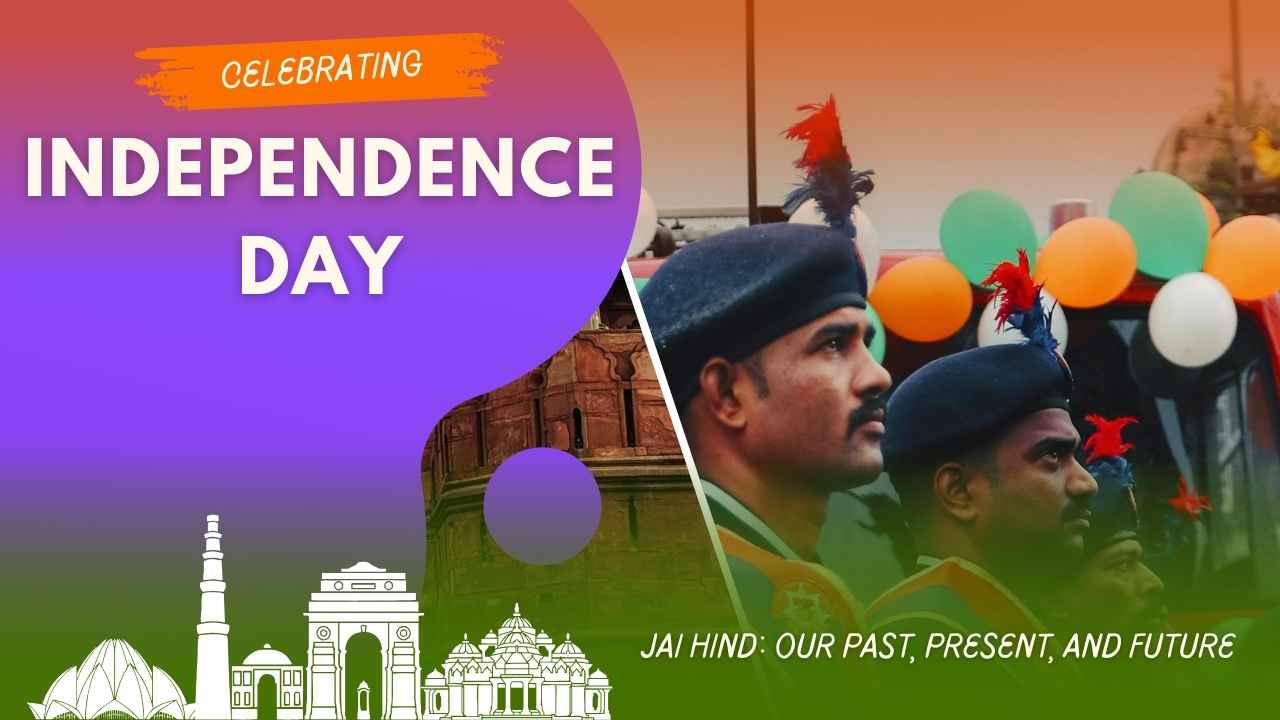
As India celebrated its 79th Independence Day on August 15, 2025, the nation witnessed powerful speeches from President Droupadi Murmu and Prime Minister Narendra Modi that captured both the spirit of remembrance and the promise of a bright future. Their addresses painted a picture of an India that has come far since 1947 and stands ready to achieve even greater heights by 2047.
Honoring Our Past, Embracing Our Future
President Droupadi Murmu’s eve-of-Independence Day address struck a perfect balance between honoring India’s freedom fighters and celebrating the nation’s remarkable journey. She reminded citizens that August 15 remains “etched in our collective memory” – a day that generations of Indians dreamed of during the long years of colonial rule.
The President’s words carried special weight as she acknowledged the pain of Partition while observing Vibhajan Vibhishika Smriti Diwas. “Today, we pay tributes to the victims of the follies of history,” she said, recognizing the millions who were forced to relocate and the terrible violence witnessed during that period. This balanced approach – celebrating freedom while acknowledging historical wounds – exemplified the mature democracy India has become.
Economic Triumph: India’s Fastest Growth Story
One of the most compelling themes in both speeches was India’s economic resilience and growth. President Murmu highlighted the country’s impressive 6.5 percent GDP growth rate in the last fiscal year, making India the fastest-growing major economy in the world. This achievement becomes even more remarkable when viewed against the backdrop of global economic stress.
The President emphasized how this growth has translated into real benefits for citizens: “A large number of people have been pulled out of poverty through good governance.” She noted that income inequality is reducing and regional disparities are disappearing, with states previously known for weaker economic performance now catching up with front-runners.
The economic transformation extends beyond mere numbers. India’s business leaders, small and medium industries, and traders have found their “can-do spirit” unleashed through the removal of bureaucratic bottlenecks. This has created a vibrant ecosystem where entrepreneurial dreams can flourish.
Operation Sindoor: Standing Strong Against Terror
Perhaps the most significant highlight of the speeches was President Murmu’s reference to Operation Sindoor, India’s decisive response to terrorism. “I believe Operation Sindoor will go down in history as an example in humanity’s fight against terrorism,” she declared, emphasizing how India responded with “steely resolve” to cowardly attacks on innocent citizens.
The operation demonstrated more than military capability – it showcased India’s unity in the face of adversity. The President noted how the nation’s response was marked by remarkable unity, with multi-party parliamentary delegations reaching out to various nations to explain India’s position. The world took notice of India’s clear stance: “We will not be the aggressor, but we will not hesitate to retaliate in defense of our citizens.”
Operation Sindoor also served as a testament to the success of the Atmanirbhar Bharat mission in the defense sector. The operation proved that India’s indigenous manufacturing has reached the critical level needed for self-sufficiency in meeting security requirements – a landmark achievement in the country’s defense history since Independence.
Infrastructure Revolution: Connecting the Nation
The speeches highlighted India’s remarkable infrastructure transformation over the past decade. The expansion and strengthening of the National Highway network under the Bharatmala Pariyojana has revolutionized connectivity across the country. The Railways have innovated with new types of trains and coaches equipped with the latest technologies.
A particularly proud moment was the inauguration of the rail link in the Kashmir valley, which President Murmu described as “a major accomplishment” and “an engineering marvel.” This historic milestone will boost trade and tourism in the region while opening new economic possibilities for the valley.
Urban transformation has been equally impressive. The number of cities with metro rail services has increased multifold in a decade. The Atal Mission for Rejuvenation and Urban Transformation (AMRUT) has ensured more households have access to tap water supply and sewerage connections. The Jal Jeevan Mission continues making progress in providing tap water supply to rural households.
Digital India: Leading the World in Innovation
In this Digital Age, India has emerged as a global leader in information technology adoption. Nearly all villages now have 4G mobile connectivity, enabling large-scale adoption of digital payment technologies. India has become a world leader in digital payments, with more than half of the world’s total digital transactions taking place within the country.
The Digital Benefit Transfer system has eliminated leakages and ensured welfare benefits reach intended beneficiaries efficiently. These developments have created a vibrant digital economy whose contribution to India’s GDP increases year after year.
Looking ahead, the government has launched the India-AI mission to strengthen the country’s AI capabilities and build models that answer India’s specific requirements. As the nation aspires to become a global AI hub by 2047, the focus remains on using technological advances to improve governance and enhance citizens’ lives.
Healthcare Revolution: Ayushman Bharat’s Impact
The healthcare sector has witnessed a paradigm shift through various initiatives under Ayushman Bharat, described by President Murmu as “the largest healthcare scheme of its kind in the world.” This scheme has already provided coverage to more than 55 crore people, with the government extending benefits to all senior citizens aged 70 and above, regardless of income.
This initiative represents more than just healthcare coverage – it embodies the principle that basic amenities of life are “rightful claims of the citizens.” By removing inequalities in access, the poor and lower middle-class can now benefit from the best possible healthcare facilities.
Celebrating Naya Bharat: The New India Vision
The theme of this year’s Independence Day celebrations was ‘Naya Bharat’ – New India. This theme captured perfectly in the decorations at Red Fort, from the Operation Sindoor logo on the View cutter at Gyanpath to floral decorations following the same theme. Even the invitation cards carried both the Operation Sindoor logo and a watermark of the Chenab Bridge, symbolizing the rise of New India.
This New India is built on the foundation of constitutional values: justice, liberty, equality, and fraternity. As President Murmu explained, these civilizational principles, rediscovered during the Freedom Struggle, all center on the notion of human dignity. Every human being deserves equal treatment, equal access to healthcare and education, and equal opportunity.
Youth, Women, and Marginalized Communities: India’s Driving Forces
President Murmu identified three sections of society that will lead India toward becoming a developed economy by 2047: youth, women, and communities that had long remained on the margins.
Indian youth have found the right environment for realizing their dreams. The National Education Policy has brought far-reaching changes, aligning learning with values and skills with tradition. Employment opportunities are booming, and for those with entrepreneurial aspirations, the government has created the most conducive ecosystem.
The space program exemplifies this youth empowerment. Shubhanshu Shukla’s upcoming space journey to the International Space Station has “fired a whole generation to dream bigger” and will prove extremely helpful for India’s human space flight program, ‘Gaganyaan.’
Women’s empowerment has moved beyond slogans to reality. A nineteen-year-old girl and a thirty-eight-year-old woman from India were finalists in the FIDE Women’s World Cup for chess championship, underlining sustained excellence across generations. The gender gap in employment continues reducing, and with ‘Nari Shakti Vandan Adhiniyam,’ women’s empowerment has become tangible reality.
Communities comprising Scheduled Castes, Scheduled Tribes, Backward Classes, and others are shedding the tag of marginalized. Government initiatives actively help them realize their social and economic aspirations.
The Path to Viksit Bharat 2047
Both speeches emphasized that India is well on its way to becoming a developed nation by 2047. The President noted that “all-round economic growth complemented by social sector initiatives has placed India well on the path of becoming a developed economy by 2047.”
This vision encompasses sustained good governance with zero tolerance for corruption. President Murmu invoked Mahatma Gandhi’s words: “Corruption and hypocrisy ought not to be inevitable products of democracy.” She called upon citizens to pledge to realize Gandhi’s ideal and weed out corruption.
Environmental Responsibility and Global Leadership
The speeches also touched on India’s environmental responsibilities. President Murmu urged citizens to protect the environment and respond to climate change challenges. “We must change our habits and our world-view. We must change our relationship with our land, rivers, mountains, and with flora and fauna,” she said, emphasizing that collective contribution will leave behind a planet where life flourishes in natural order.
A Message of Unity and Self-Reliance
The underlying message throughout both speeches was one of unity and self-reliance. The spirit of Swadeshi, commemorated through National Handloom Day on August 7, continues inspiring national endeavors like Make-in-India and Atmanirbhar Bharat Abhiyan. President Murmu called upon citizens to “resolve to buy and use Indian products.”
This self-reliance extends beyond products to capabilities. India’s response to terrorism through Operation Sindoor, its achievements in space exploration, its leadership in digital payments, and its growing manufacturing capabilities all demonstrate a nation confident in its abilities and ready to take on global challenges.
Looking Forward with Confidence
As India celebrated its 79th Independence Day, the speeches painted a picture of a nation that has transformed dramatically since 1947. From a country in “utter poverty” at independence to the world’s fastest-growing major economy, India’s journey exemplifies the power of democratic values and determined effort.
The vision for 2047 – when India will celebrate its centenary of independence – is not just about economic development. It’s about creating a society where every citizen can live with dignity, where innovation flourishes, where unity prevails over division, and where India stands as a beacon of hope for the world.
President Murmu concluded her address with the rallying cry of “Jai Hind! Jai Bharat!” – words that captured the spirit of a nation confident in its past, engaged with its present, and optimistic about its future. As India moves forward during the Amrit Kaal, the path to Viksit Bharat 2047 seems not just achievable but inevitable.
The speeches of Independence Day 2025 will be remembered not just for their celebration of achievements but for their articulation of a vision that inspires every Indian to contribute to the nation’s continued journey toward greatness.